Nancy C. Braman, Esquire
2025 Pegasus Scholarship Report
Who, What, When, Where, Why?
Hello! My name is Nancy and I was fortunate to be chosen as a 2025 American Inns of Court Pegasus Scholar. I have been practicing intellectual property law in Boston since 2020 both as a transactional patent attorney and as a patent litigator. My path to becoming a lawyer was highly unusual, especially for someone practicing IP law. I was raised in Palmer, Alaska, and before pursuing a legal career I worked as a commercial fisherman for six years in the remote wilderness of Bristol Bay. The path has been winding at times, but I firmly believe that anyone can accomplish anything even without traditional advantages. I also strive to be an example for women interested in pursuing careers in male-dominated industries.
My education led me to schools across the northern regions of the U.S. before I landed in Massachusetts and started my legal career. I joined the Alan D. Lourie Boston IP American Inn of Court in 2022.
Program Prep
 When I found out that I was chosen as a Pegasus Scholar I was determined to make the most of the program. This meant doing some prep work before the program officially began. Over the next couple of months I was put in contact with my California-based co-scholar, Garvey Vincent. I knew we would get along due to our shared roots (#westcoastbestcoast), and that was quickly confirmed when we met over video and immediately started cracking jokes. We became great friends during the program and even earned the nickname “The Dynamic Duo” from the Temple Bar Scholars, who said Garvey and I were like siblings. The Temple Bar Scholars are a group of four lawyers chosen from a pool of high-achieving U.S. law clerks, who take part in a separate London-based four-week Temple Bar Scholarship program run by the American Inns of Court.
London Amity Visit
The first week in London was a whirlwind because it included the 35th Anniversary Amity Visit for the Pegasus Scholarship program. The schedule was packed full of meetings with prominent members of the English Bench and Bar. After a couple of administrative tasks relating to our visas, Garvey and I met up with the other scholars, our incredible program coordinator, Cindy Dennis, and the new American Inns of Court (AIC) Executive Director LTG Joseph Berger III, U.S. Army (ret.) (formerly the highest-ranking lawyer in the U.S. Army) at the National Pro Bono Centre. The Hon. Mr. Justice Knowles CBE was kind enough to meet with us and discuss the role that pro bono plays in the UK legal system. We learned that the UK faces similar issues as the U.S. regarding access to justice for those unable to afford legal assistance. For example, oftentimes in the UK assistance is only available in criminal proceedings and even then it can be limited. I am very passionate about my pro bono practice (especially my work with survivors of domestic abuse), so I found it particularly interesting that, in the UK, there is a cut-off for when a person can request assistance with a legal proceeding. Justice Knowles said that typically pro bono assistance can only be requested if a legal proceeding is at least three weeks out. This is in sharp contrast to my practice, where a client will oftentimes reach out to Northeast Legal Aid in Boston within days of a hearing to request pro bono representation.
After our meeting with Justice Knowles, we proceeded to one of the four English Inns of Court, The Honorable Society of the Inner Temple, for a meeting and lunch with leaders of the Bench and Bar. We were able to ask detailed questions regarding some of the key differences between barristers and solicitors in English legal practice and learned that all barristers must be a member of one of the four Inns.
We wrapped up the afternoon with a tour of the Old Bailey Central Criminal Court, led by His Honor Judge Leonard KC. The Old Bailey hears criminal cases of the most serious nature, such as those including charges of murder and terrorism. Judge Leonard pointed out key features of the courtrooms, including a witness box situated next to the jury that had a roof and curtains, which were carried over from the older days of the court and would shield the witness both from the elements and the defendant, whose box was situated on the other side of the courtroom. It was also notable that as opposed to an American court room, where the jury often sits to the side of the room between the Bench and counsel, the jury in this court was situated both above and in front of counsel. There was also a glass pane shielding counsel from the defendant.
Following the tour we attended a reception at the Old Bailey with former Pegasus Scholars from the U.S., as a part of the 35th Anniversary Amity Celebration.
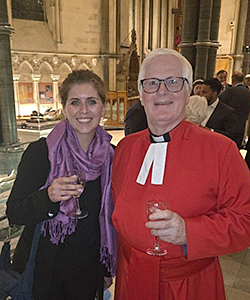 The second day began with a fascinating walking tour of Legal London led by barrister Lucinda Orr, a former British Pegasus Scholar to the U.S. We toured the areas around two of the Inns of Court, Inner and Middle Temple, as well as the Royal Courts of Justice, and learned all kinds of historical facts regarding, e.g., the history of the Inns, the War of the Roses, etc. Following the tour, we met up with the Amity Visit Scholars for a briefing on the Pegasus Scholarship Trust to learn more about the goals of the trust in fostering international legal scholarship. We then toured our second Inn of Court, The Honorable Society of the Middle Temple, where we had lunch and engaged in discussions and friendly banter with various Inn leaders. Our final tour of the day was a tour of the Temple Church with The Reverend Robin Griffith-Jones. The Temple Church is situated between Inner and Middle Temple. It dates back to the year 1185 and was the location of the negotiation of the Magna Carta. The beautiful and quaint Temple Church also boasts remarkable acoustics that I enjoyed while attending various events and musical performances during my stay.
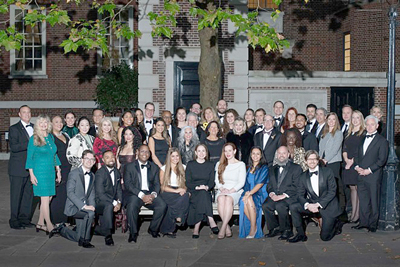 In the evening, the Pegasus and Temple Bar Scholars reconvened with over 70 former scholars, members of the judiciary, and members of the American and English Inns of Court for the Pegasus Trust American Inns of Court Amity Dinner. It was a lovely evening surrounded by fascinating people at the top of their field in various areas of law in England and the U.S.
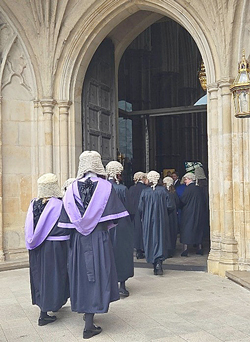
On Day three, we attended the Opening of the Legal Year (OLY) at Westminster Abbey. The ceremony included senior members of the judiciary, prominent barristers and solicitors, law officers, and international legal figures. The ceremony also drew crowds of onlookers outside of the gates, who photographed us curiously as we exited the Abbey. We enjoyed observing the members of the judiciary as they appeared in their formal robes and wigs, a traditional form of legal dress unique to the United Kingdom.
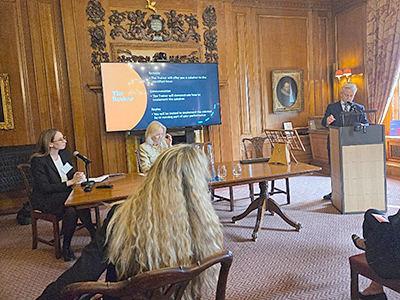 Following the OLY, we attended a presentation on cross examination techniques by Sarah Clarke KC, with an insightful demonstration by John Burke and Caroline Merck who are both former Pegasus Scholars. In the evening, we attended the First Choral Evensong of the Legal Year and accompanying reception at the Temple Church.
On Day 4, we met with many prominent members of the English judiciary. We met with the judiciary at the Royal Courts of Justice, starting with the Lady Chief Justice of England and Wales. She is the head of the judiciary of England and Wales and the president of the courts of England and Wales, and is the first woman to hold the position. The Lady Chief Justice is also a 1987 British Pegasus Scholar to the United States. She explained that unlike the U.S. court system, where clerks write draft opinions for judges to review and edit, English judges write their own opinions and rely on judicial assistants for other tasks, such as conducting any necessary research. We also met with the Master of the Rolls, a position famously held by Thomas Cromwell who was executed for treason and heresy under King Henry VIII. The Master of the Rolls is the senior judge and head of the Civil Division of the Court of Appeal in England and Wales, and the second-highest-ranking judge in the country after the Lady Chief Justice. He explained to us the importance of and his focus on digitizing documents in the English court system, because digitizing documents “creates access to justice.” He is also writing a book about the history of the Master of the Rolls position and is very passionate about the project, because nothing like this had been written about it before.
We then met with barristers for lunch at our third Inn of Court, Gray’s Inn, where we had the opportunity to ask even more questions about the various idiosyncrasies regarding legal practice in the UK. After lunch we had a preliminary visit to the Supreme Court of the United Kingdom for briefings with The Rt. Hon. Lord Reed, President of the Supreme Court, and The Rt. Hon. Lord Stephens. Unlike the judiciary of England and Wales, the Supreme Court is independent of the government of the UK, of Parliament, and of the court services of England and Wales, Scotland and Northern Ireland. It is the final court of appeal in the UK for civil cases, and for criminal cases from England, Wales and Northern Ireland (but not Scotland, whose highest criminal cases are heard by Scotland’s High Court of Justiciary). The UK Supreme Court also remains the final court of appeal for other Commonwealth countries who have chosen to appeal to the court, and we had the opportunity after the briefings to sit in on one such appeal that day from Trinidad and Tobago.
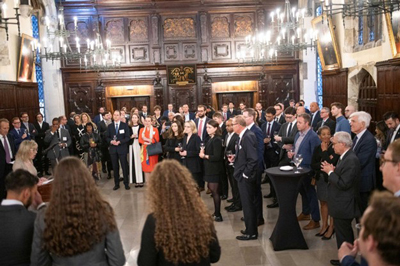 Following our visit to the Supreme Court, Garvey and I attended a swearing in ceremony at the Royal Courts of Justice for Lord Justice James Dingemans of the UK High Court. The Lady Chief Justice presided, and her speech was both humorous and heartfelt as she welcomed the new Lord Justice to the High Court. We finished the evening with a reception to honor our friends, The Temple Bar Scholars, and were introduced to the Commercial Bar at the fourth and final Inn, Lincoln’s Inn.
On the fifth day of the program, we had the opportunity to visit the Bar Council and speak with Chair Barbara Mills KC about efforts and reforms taking place in the UK legal community, especially regarding concerns about diversity in the bar.
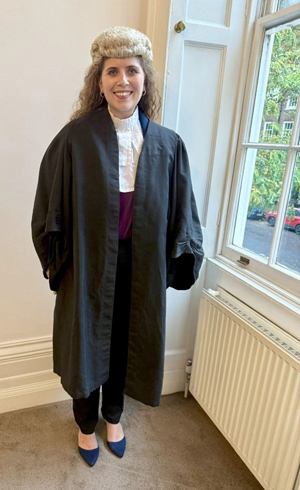 We then took an in-depth tour of Lincoln’s Inn and had lunch with prominent members of the Inn. Due to its dramatic architecture, Lincoln’s Inn has been a choice filming location for decades. Popular shows and films that have used the Inn for filming include Downton Abbey, Harry Potter, and Sherlock Holmes, to name a few. Following our time at Lincoln’s Inn, we were treated to afternoon tea by barristers at 33 Bedford Row Chambers to discuss the life of a practicing barrister in England. We also had a great deal of fun trading courtroom war stories and trying on the traditional robes and wigs of an English barrister that are required for court appearances.
Finally, to close out the busy week, we had dinner with the Amity visiting scholars (before they returned to the U.S.) and the British Pegasus Scholars from years past. We could not have asked for a more vibrant group of U.S. lawyers to spend the week with.
London Placement Highlights
The Supreme Court of the United Kingdom
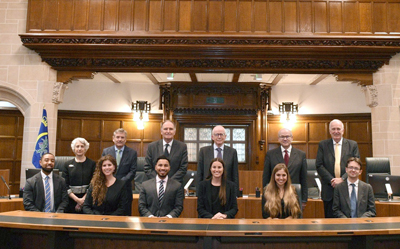 As a part of our time in London, the Pegasus and Temple Bar Scholars were honored with placements at the Supreme Court of the United Kingdom. I was fortunate to have an incredibly engaging placement with the Rt. Hon. Lord Hamblen of Kersey. I was given the opportunity to advise Lord Hamblen on the state of patent law pertaining to AI inventions in the United States and the European Union, an area of law that did not have as much existing precedent in the UK. It was a highly complex issue, and I was thrilled to have the opportunity to bring my knowledge to the table as a U.S. practitioner.
On a very special evening, we were invited to attend a dinner at the House of Lords with our justices. The House of Lords is one of two chambers of UK Parliament, located in the Palace of Westminster in London and across the street from the Supreme Court. As the legislative upper house, it shares the responsibility of creating and shaping laws with the House of Commons and holding the government accountable through debates and questions. I was happily situated between Lord Hamblen and Lord Reed, with whom I had lively discussions about what it was like to be knighted by Queen Elizabeth II and the best scotch to try when we made it up to Scotland.
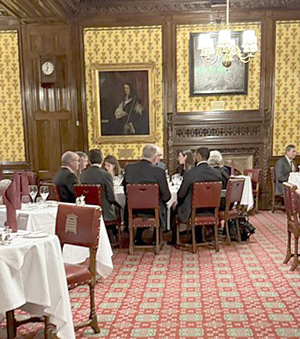 Lord Hamblen also invited all of the scholars to a reception for the Society of English and American Lawyers (SEAL), an organization for which he currently serves as President. SEAL’s mission is to build a cross-cultural community of lawyers from both England and the U.S. This was a great chance for us to network not only with English lawyers, but also American lawyers who are now living in London.
My time at the Supreme Court was phenomenal. Not only was it educational, but it also gave me the opportunity to do impactful work in a complex area of law that I know well.
Barristers’ Chambers
During my time in London I also had a fantastic placement in barristers chambers at One Crown Office Row with former British Pegasus Scholar Jonathan Metzer and his wonderful colleague, Paula Kelly. I was able to observe a variety of hearings and trials with barristers from One Crown Office Row, neighboring Goldsmith Chambers, and Legis Chambers. The proceedings I observed included extradition appeals, asylum appeals, commercial hearings, traffic violation appeals, and two days of a five day sexual assault trial at Wood Green Crown Court. I noticed some key differences in the English legal system during these observations, which I will highlight below:
- Jury selection, and even the ability to demand a jury trial, is far more limited than in the U.S. In fact, jury trials are typically only available in serious criminal cases in the UK. Additionally, jury selection is extremely quick in comparison to the U.S. system. As a U.S. practitioner, I was shocked to witness jury selection for a sexual assault trial at Wood Green Crown Court that took less than 20 minutes. My American legal mind was blown!
- Garvey and I had the opportunity to observe John Burke, former U.S. Pegasus Scholar and now dual-qualified English barrister and American lawyer, at Luton Magistrates’ Court. John represented “the Crown” that day in multiple offenses by multiple defendants. It is interesting to note that he could have just as easily represented the defendants given that criminal barristers can be hired to represent either side, which does not typically happen in the U.S., since American criminal lawyers are typically either prosecutors for “the State” or defense attorneys. We were shocked to discover that Magistrates in England are laypeople and not members of the judiciary, as opposed to Magistrate Judges in the U.S.
The UK Intellectual Property Office (Newport, Wales)
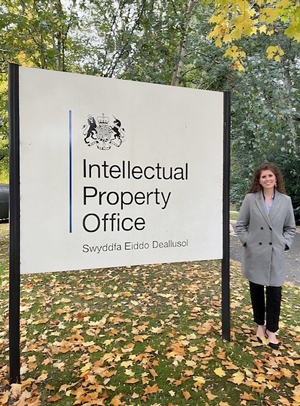 When I arrived in the UK, I mentioned to Jonathan Metzer that as a U.S. patent attorney, I was interested in visiting the UK Intellectual Property Office (IPO). Initially what was supposed to be a lowkey visit turned into a professional opportunity to present to hundreds of IPO patent examiners on U.S. patent law and litigation. On the day of my visit, I was greeted by multiple patent examiners who were kind enough to buy me lunch and give me a tour. The program I prepared consisted of a presentation and a mock patent trial voir dire (jury selection). I chose to incorporate a mock voir dire because so many UK legal practitioners had expressed curiosity at the widespread use of juries in U.S. civil trials. It therefore came as no surprise when the IPO patent examiners were shocked at the thought of using juries in cases involving complex technology. The presentation garnered a lot of laughs and numerous insightful questions from both the in-person and online audiences. I thoroughly enjoyed my visit to the UKIPO, and I was floored to have such a large audience on short notice!
Norton Rose Fulbright Solicitor Placement
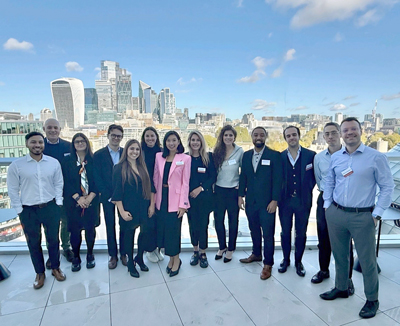 To finish an incredible month in London, we spent our final day meeting with English solicitors at law firm Norton Rose Fulbright while enjoying a marvelous lunch overlooking the River Thames. Our host was Peter Young, a New York capital markets lawyer based in the firm’s London office and head of the firm’s capital markets practice. I thoroughly enjoyed our conversation, especially regarding his life as a dual-qualified U.S. lawyer and English solicitor working overseas. His colleagues were also highly engaging and a joy to get to know. Norton Rose Fulbright’s hospitality was a perfect way to end our London program!
London Activities
By the end of our time in London, I had gone to more shows and events than I ever have in any other city. Every single night I had plans with the other scholars, former scholars, or barristers whom we had met during the program. There was always something to do or see, and none of us wasted any time.
The Hague & Amsterdam, The Netherlands
 At the end of our professionally rewarding experience in London, Garvey and I parted ways with our friends, the Temple Bar Scholars, and continued onward to the Netherlands. We split our time in the Netherlands between The Hague and Amsterdam, where we had the opportunity to meet with prominent legal practitioners and enjoy the local culture and beautiful European architecture.
 While in The Hague, we had the honor of being invited to lunch with Judge Johanna Korner CMG KC of the International Criminal Court (ICC). The International Criminal Court (ICC) investigates and tries individuals charged with the gravest crimes of concern to the international community: genocide, war crimes, crimes against humanity and the crime of aggression. Judge Korner is originally from England, where she was a criminal barrister and judge of the Crown Court of England and Wales prior to joining the ICC. We engaged in fascinating discussions regarding the state of international criminal law and about her path to the ICC.
We also had the pleasure of meeting with Specialist Prosecutor Kim West at Kosovo Specialist Chambers (KSC). KSC is a court of Kosovo and located in The Hague. It delegates the trials of war crimes committed specifically by members of the Kosovo Liberation Army (KLA) concerning the period 1998-2000, during and at the end of the Kosovo War and directed afterwards against ethnic minorities and political opponents. Attorney West is a former U.S. federal prosecutor with extensive experience in international criminal investigations. We learned about her current and prior work in The Hague and had the opportunity to ask extensive questions about her career in international criminal law. We were also given a tour of the courtroom used during the Kosovo criminal proceedings. Unlike many other courts, the KSC is extremely modern with advanced technological capabilities, such as real-time translation of witness testimony and extensive capabilities pertaining to the public broadcasting of proceedings.
In our spare time, Garvey and I enjoyed visiting the Mauritshuis in the Hague, an art museum that houses the famed Girl With a Pearl Earring painting from Dutch painter Johannes Vermeer. We also had the opportunity to visit Amsterdam (only a 40-minute train ride away), where we visited the Anne Frank House and toured the city via a beautiful canal boat tour.
Manchester, England
After returning to the UK, we traveled to Manchester where we met former British Pegasus Scholar to the U.S., Liam Kelly. We had insightful and passionate discussions and thoroughly enjoyed a witty banter throughout our time in Manchester.
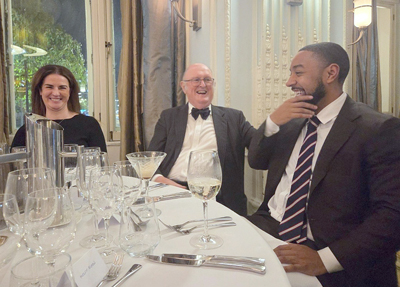 Liam introduced us to his colleagues in Deans Court Chambers and we had the opportunity to attend Northern Circuit Mess, a dinner that brings the legal community together. It reminded me a bit of my own Inn of Court meetings in Boston. I was also fortunate to have coffee with intellectual property associate, Michael Rimola, of JMW Solicitors in Manchester. It was lovely to have a relaxed meeting with another associate and discuss our experiences in dispute resolution in the IP space.
Finally, one of my favorite days in Manchester was spent shadowing His Honor Judge Nigel Bird, Designated Civil Judge of the Manchester Civil Justice Centre, on an agency decision appeal in a housing case. Judge Bird asked us to sit on the bench with him while he heard arguments from barristers representing both the local housing authority and the appellant.
Throughout the day, Judge Bird discussed his decisions in the case with us, and spent time debriefing with us when the hearing was concluded.
Edinburgh, Scotland
From Manchester, we hopped on an afternoon train up to beautiful Scotland. For the rest of the trip we spent our days with other Pegasus Scholars from Commonwealth countries around the world, including Australia, New Zealand, Malaysia, and India.
The following morning, the Pegasus Scholars did a tour of the Faculty of Advocates. The Faculty of Advocates is an independent body of lawyers who have been admitted to practise before the courts of Scotland, but they are styled as “advocates” as opposed to “barristers” in the rest of the UK. The tour was highly informative, and we had the chance to meet with a senior advocate to ask questions about practice in Scotland.
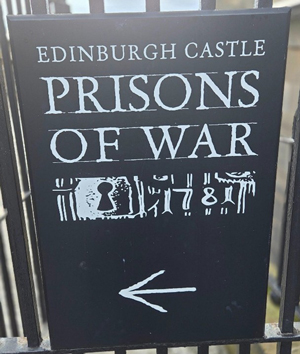

In our down time we did a tour of the Royal Mile and of the beautifully eerie Edinburgh Castle. Edinburgh Castle has served many purposes over the years as a royal residence, prison, and military fortress, to name a few. It was involved in many historical conflicts related to the Wars of Scottish Independence and was even used to hold prisoners of war in the American Revolutionary War.
Garvey, Lachlan, and I also enjoyed a fun evening participating in an underground scotch whisky tasting (spirits from Scotland are spelled “whisky,” not “whiskey” like American spirits).
 On our final day in Edinburgh, Garvey and I met up with Poppy Mulligan, a Scotland native and former judicial assistant at the Supreme Court of the United Kingdom in London. There are very few judicial assistants from Scotland (most come from England), so it was interesting to discuss her experience and her perceived differences between the legal systems in England and Scotland.
Belfast, Northern Ireland
Garvey and I opted to fly to Belfast, where we stayed downtown within a short walk to City Hall.
 The following morning, we met with local judges at Laganside Court, including Mr. Justice Kevin Rooney KC of the Northern Ireland High Court. Justice Rooney spoke to us about the difficulties that Northern Ireland has seen in decades past, in a period of time referred to as “The Troubles” (or the “Northern Ireland Conflict”). The conflict lasted for roughly 30 years and largely ended in 1998 with the Good Friday Agreement. Justice Rooney explained that the conflict had been brewing for a long time, but was heightened in 1972 after "Bloody Sunday," a massacre in Derry, Northern Ireland, where British soldiers shot and killed unarmed protesters (events of which inspired the U2 song Sunday Bloody Sunday). We learned that during related criminal prosecutions, Northern Ireland used “Diplock” courts, which were criminal courts in Northern Ireland for non-jury trials of serious crimes that came with an automatic right of appeal. These cases were sent to individual judges, as opposed to juries, because the government believed that juries would have been too biased one way or the other to be truly impartial. Justice Rooney explained the thought process behind it, that because a judge would have to justify their judgment in writing, it would be less susceptible to bias. He noted that in the present day, some Caribbean countries also use Diplock judges for serious gang offenses due to similar concerns regarding tainted jury pools.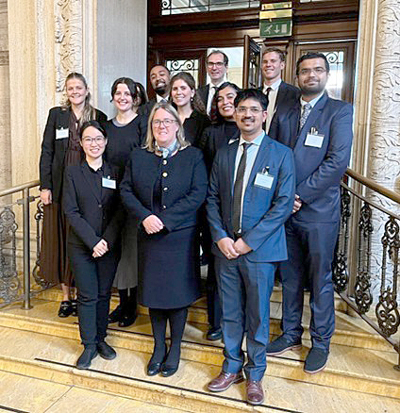
 I ended my time in Belfast with a tour of the Titanic museum, a visit to Bushmill’s Distillery up north, and because of our fascinating discussion with Justice Rooney and my interest in history, a walking tour that focused on The Troubles.
In the afternoon, we had lunch with The Rt. Hon. The Lady Chief Justice of Northern Ireland at the Royal Courts of Justice (RCJ). She is the highest-ranking member of the judiciary in Northern Ireland, and the first woman to hold this position. She asked all of us specific questions about legal practice in our respective countries and made interesting comparisons between our legal systems and the system in Northern Ireland. We also toured the RCJ, where I was particularly interested in the color of the carpet. The carpet beneath the Bench and all hallways and offices of the court had red carpet, whereas the areas permitted for counsel and the public had green carpet. This displayed a notable separation between the public and the court.
The Experience of a Lifetime
If you are looking for a program that fosters international connection and friendship, look no further than the Pegasus Scholarship. Your understanding of the global legal market will deepen, and your network will grow overnight. This is an incredible opportunity for young lawyers, so as the British would say, I am very grateful. Cheers!