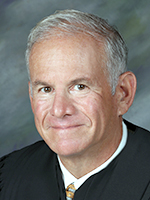
 Cale Bradford’s future in the legal profession seemed predestined: His father, a lawyer, named him after Cale Holder, a district judge for the Southern District of Indiana he admired greatly. “I do not know that I had any choice,” laughs Bradford, who has been a judge for the Indiana Court of Appeals since his appointment in 2007. “I had had the opportunity to observe how my dad had helped a lot of people, so my polestar was being a lawyer.”
After earning an undergraduate degree in labor relations and personnel management from Indiana University (IU) Bloomington in 1982, Bradford went on to earn his law degree from the IU Robert H. McKinney School of Law in 1986.
But Bradford did not just get his first name from his dad. He also inherited his father’s pragmatism, a quality that makes Bradford a treasured resource in the legal community. When a tough decision needs to be made, the solution is often found when someone says, “Well, you know what Judge Bradford always says …,” says Timothy W. Oakes, a former mentee who is now a judge at the Marion Superior Court in Indianapolis. “Cale has always maintained a folksy and personal way of taking some of our most difficult situations or decisions in our lives and opening our eyes to a better solution.”
“My dad was very much a bottom-line person,” Bradford says. But, he adds, you cannot get to the bottom line too fast: You have to sift through everyone’s arguments and remain calm when others are not. “But when it comes down to it, the law is based on common sense. And I am grateful to God for blessing me with a lot of that.”
Bradford served as chief judge of the Indiana Court of Appeals from 2020 to 2022. “I was the COVID chief,” says Bradford, who spent his three-year term figuring out issues such as remote work protocols, cybersecurity, and the Great Resignation, when large swaths of employees voluntarily resigned from their jobs during the pandemic.
Before joining the Court of Appeals, Bradford served for more than a decade as a judge for the Marion Superior Court, spending seven years in the criminal division and three in the civil division. He also served two terms as presiding judge.
During that time, he chaired the Marion County Criminal Justice Planning Council, a group of local officials who tackled jail overcrowding and other criminal justice challenges. The result was the end of three decades of federal oversight of the county’s jail plus security improvements in the county’s juvenile detention system.
Indianapolis had an extremely high murder rate, leading to jail overcrowding and early releases, Bradford explains. To fix the problem, the council focused on alleviating the little problems that fed into the bigger problem. That might mean working to resolve multiple cases for one prisoner at the same time so that person is not hanging around the county jail because they have three misdemeanors, Bradford explains. Or, it could mean ensuring police departments have enough staff to transcribe taped statements so that cases can go to trial in a timely fashion.
On the juvenile side, the problems included overincarceration of youth, overrepresentation of minorities, and recidivism. The council turned for help to the Annie E. Casey Foundation’s Juvenile Detention Alternatives Initiative. Indianapolis became a model city in the program, which has now spread to nearly every county in the state. “There are probably half as many youth incarcerated in the county than there were 15 or 20 years ago,” Bradford says.
Prior to becoming a judge, Bradford worked in the Marion County Prosecutor’s Office, where he oversaw more than 100 attorneys. He was also an assistant U.S. attorney for the Southern District of Indiana, where he prosecuted major drug trafficking cases. From 1986 to 1991, he was in private practice.
Bradford is also a former board member of the John P. Craine House, a residential alternative to incarceration for women offenders with preschool-aged children. For more than a decade he taught forensic science and the law as an adjunct university instructor.
When Bradford is not working, he spends time with his wife, a retired kindergarten teacher, at their home on Lake Tippecanoe. Bradford also enjoys long-distance running, fishing, barefoot water-skiing, and golf. But his main priority? Serving the public.
“Lawyers and judges alike have to be so careful to protect the justice system; it is the last place you go when you have a grievance,” he says. “People make lawyer jokes, but never about their own lawyer.”