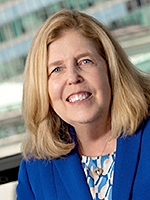
 Vilia B. Hayes, Esquire, attributes her passion for providing legal services to the underserved to two factors: her Catholic education and the Civil Rights Movement.
“Growing up in the 1960s, the whole idea of the Civil Rights Movement and my Catholic education made me feel like I had an obligation to take care of the poor,” says Hayes, a long-time partner at the New York law firm Hughes Hubbard & Reed LLP, who became senior pro bono counsel at the firm upon her retirement. “And then I was at Fordham University for law school, where the motto is ‘in service to others.’”
Hayes took a roundabout route to law school. After graduating with honors from Marymount College in 1972, she got married, had a child, and took on teaching and other part-time jobs. Once her son was ready to go to school, so was she. She earned a cum laude law degree from Fordham University School of Law, where she was associate editor of the Fordham Law Review.
To her family, that turn of events seemed only natural. “My sister says, ‘Dad said you would be a lawyer when you were five,’” laughs Hayes, a former high school debater. “I had strong views and could argue my position.”
As senior pro bono counsel, Hayes litigates pro bono cases involving such issues as prisoner rights, voting rights, immigration, family law, and housing. Some of her most rewarding cases have been helping victims of domestic violence and similar crimes get U visas that allow them to apply for green cards, helping unaccompanied minors get green cards, and helping women with AIDS with their legal issues. “Pro bono matters are a very big part of what I view as my life’s work.”
Hayes also co-chairs the firm’s pro bono committee and supervises many pro bono matters in both federal and state court. “Part of how I view my role as pro bono leader is to encourage people to do cases for different reasons—because you have an obligation to do it as part of your morality almost, that because of your privilege you really should try to help,” she says. “And it is good for you. You learn how to do things in different ways and learn how to do things faster than in paid work.”
Previously, Hayes spent more than 35 years working as a litigation associate and then partner. Her specialties included employment, product liability, insurance, bankruptcy, and commercial litigation. She also offered counseling and negotiation related to employment and insurance law. “I did a lot of product liability work,” she says. “I did employment work for a while, then insurance defense.” Hayes clerked for U.S. District Judge Charles L. Brieant of the Southern District of New York.
It was Brieant who introduced her to the Federal Bar Council. “I got to meet a lot of judges in different settings and was asked to do a lot of things,” says Hayes, who went on to become the organization’s president from 2014 to 2016. She also served as the president of the New York American Inn of Court from 2012 to 2014.
These days, Hayes is a member of the board of directors for the Lawyers Committee for Civil Rights Under Law, a nonpartisan nonprofit organization that uses legal advocacy to advance racial justice. She is also a member of the advisory board of Legal Momentum, a program of the Women’s Legal Defense and Education Fund. The organization seeks to help girls and women realize their full potential by advancing equity in education, the workplace, and the courts.
Hayes has tried to fulfill that goal in her own professional life, mentoring women and other underrepresented individuals in the legal field and allowing women employees to work part-time even before such flexible arrangements were common.
The colleagues who nominated Hayes for the award attribute that commitment to Hayes’s background. “Vilia grew up without the benefits of family wealth, connections, and education, in an environment that was not especially encouraging of the intellectual or professional development of female children,” wrote Gerard E. Lynch of the U.S. Court of Appeals for the Second Circuit and other nominators. “The obstacles that faced Vilia as a young woman have clearly shaped her understanding of the need for legal services among those who cannot afford to pay Wall Street rates, and of the need for support and mentoring of young lawyers, especially for young women, members of minority groups, and first-generation college and law school graduates.”