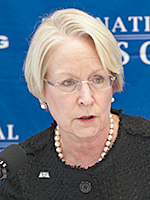
 When Judy Perry Martinez, Esquire, was growing up, her family had a furniture store in the Upper Ninth Ward of New Orleans. But when her parents fell on hard times, they lost the business and nearly their home.
“I saw them struggling to get affordable legal help,” Martinez remembers. “It really made me understand that if they—my mother had been a teacher, and my dad had graduated from Tulane University—could not do it, what did other people do?” That experience stuck with Martinez even as she studied marketing at the University of New Orleans, where she graduated in 1979. “That real-life experience certainly colored my belief that access to justice for everyone is a promise of our country,” she says.
The experience helped propel Martinez into a legal career, especially after a professor in a labor law course in her undergraduate program urged her to go to law school. She earned a cum laude law degree from Tulane University Law School in 1982. Today, she is of counsel at Simon, Peragine, Smith & Redfearn LLP, where she also worked between 1982 and 2003 as a commercial litigator, partner, and member of the governing committee.
“I spend my time now on issues of importance to me in terms of the profession and of those we serve,” she says. “I do a lot of policy work and work for nongovernmental organizations. I am so fulfilled.”
After finishing her first stint at Simon, Peragine, Smith & Redfearn in 2003, Martinez joined Northrop Grumman Corporation and oversaw litigation for the western half of the United States. By 2011, she had been named vice president and chief compliance officer. She also served on the company’s Diversity and Inclusion Leadership Council.
After retiring from Northrop Gruman in 2015, Martinez became a fellow in residence at the Advanced Leadership Initiative at Harvard University. At Harvard, she focused on the children of death row inmates; she still works in the criminal justice reform arena, such as testifying about legislation last year. Martinez then returned to New Orleans to focus on public service at Simon, Peragine, Smith & Redfearn.
Throughout her career, Martinez has been active in the American Bar Association (ABA). She served as the association’s president from 2019 to 2020. In 2011, she chaired the ABA Standing Committee on the Federal Judiciary, which evaluates all nominees to the federal bench and then served as ABA Representative to the United Nations. More recently, she chaired the ABA Presidential Commission on the Future of Legal Services.
“Once you have the opportunity to serve the association in the way I did, they never let you go,” she laughs. She also served on the board of directors of the American Bar Foundation. She is a fellow of the Louisiana Bar Foundation and a member of the American Law Institute.
Deeply committed to public service, Martinez helped establish the New Orleans Pro Bono Project in 1986. She currently serves as the president of the World Justice Project, an international group that works to advance the rule of law around the world. The organization produces an annual Rule of Law Index, which evaluates 142 countries and jurisdictions and also works to improve those scores.
“We know there is a correlation between a healthy rule of law score on the index and educational levels, gross domestic product in a country, health, and peace,” she says, adding that many might be surprised to learn that the United States ranks only 26 on the index. “I spend a lot of my time as a volunteer with that organization.”
She also does a lot of work for the Legal Services Corporation, the Louisiana and New Orleans bars, and her law school. “It makes my heart sing to go back and give back,” she says of giving talks at her alma mater.
When Martinez is not working, she spends time with her husband, children, grandchildren, and friends, whether through a backyard barbeque or a crawfish boil. In her kitchen hangs a little plaque that says, “To the World You May Be One Person, But to One Person You May be the World.,” a constant reminder of the professor who first suggested she pursue a legal career.
“I think about that all the time: Had he not suggested I go to law school, would I have become a lawyer?” she muses. “That experience has really driven me to take time, especially with young people, to explore what they are doing, what their interests are, and whether they can contribute to the legal profession and those we serve.